Stablecoins and Regulation in 2026: What the New Rules Actually Change for Traders
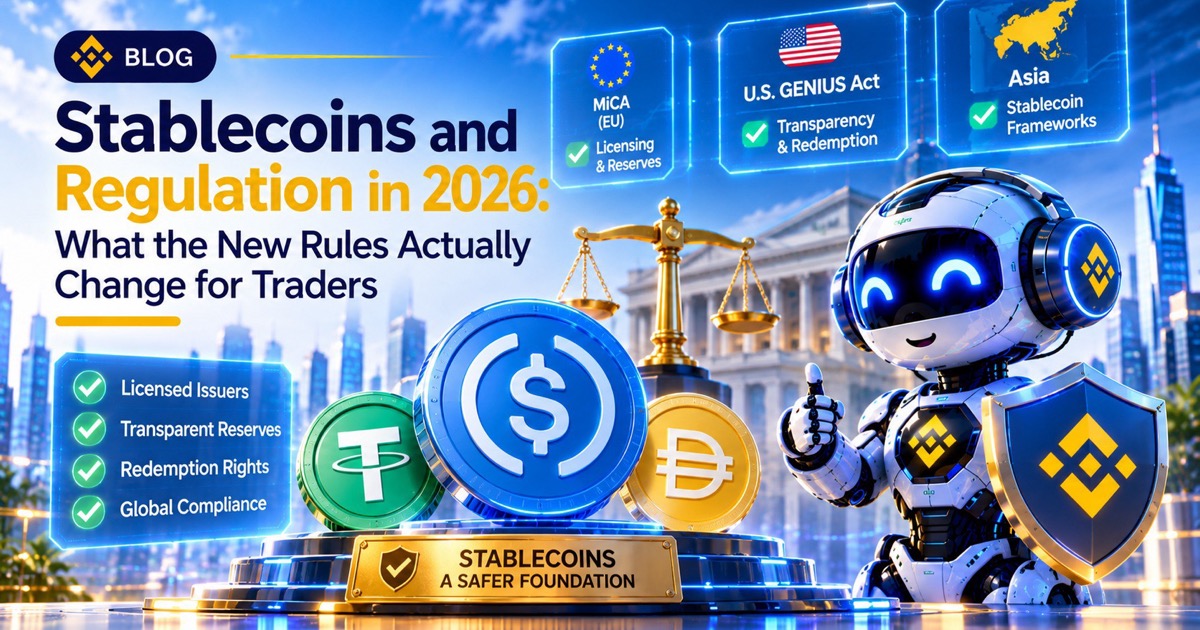
For years the most important asset in crypto — the stablecoin sitting in every trading pair — ran on vibes and auditor letters. That era is over: the EU's MiCA regime is in force, the US has federal stablecoin legislation, and major Asian markets have licensing frameworks of their own. Here's what actually changed and what it means if you're a trader, not a lawyer.
What the new rules actually require
- Issuers need licenses and capital — fly-by-night stablecoins lose legal standing
- Reserves must be transparent and liquid — high-quality assets, regular attestations
- Redemption rights — in the EU, holders of regulated coins can redeem at par in defined conditions
- Foreign coins face restrictions — unlicensed issuers get delisted from compliant venues in regulated markets
Why traders should care about 'boring' rules
Your trading stack stands on stablecoins: pairs quote against them, bots hold them between positions, PnL is measured in them. Regulation attacks the two historic tail risks — an issuer quietly becoming insolvent, and a depeg spiraling with no redemption floor. Neither was hypothetical: the industry remembers coins that promised dollars and held paper. Statutory reserve rules convert 'probably fine' into 'verifiably fine', which for systematic trading is infrastructure, not paperwork.
What it means for small traders specifically
- Venue quality rises — regulated exchanges delist non-compliant coins, shrinking the menu to the audited tier
- DeFi spillover — liquidity migrates toward compliant coins; deep pools follow legality now
- Operational diligence gets simpler — 'which major licensed issuer' is an easier question than 'which coin seems solvent'
- Tax and reporting alignment — clean stablecoin rails make accounting cleaner almost everywhere
What to watch next
- Enforcement posture toward non-compliant legacy coins in offshore venues
- Bank-grade issuers entering — competition compressing the 'stablecoin premium' business
- Cross-border互认 — whether US/EU/Asia frameworks interoperate or fragment rails
- Privacy vs compliance tension at the edges of DeFi
Where our agent sits
Nothing about the trading engine changes — strategies price action and liquidity, not legislation. What regulation improves is the layer underneath: the quote asset your bot holds between trades is becoming categorically safer. We treat that as quiet, compounding good news for anyone running systematic strategies through full cycles.
Frequently asked questions
- Do I need to switch stablecoins because of the rules? — If you trade on regulated venues in regulated markets, compliant coins are mostly what's offered anyway. Offshore, preference for licensed issuers is prudent but not mandated — decide based on where your venue and you legally sit.
- Can a regulated stablecoin still depeg? — Market stress can wobble any price briefly. The difference is the redemption mechanism and verified reserves — wobbles have a floor instead of a narrative.