Agentic Wallets and Non-Custodial Trading: Where Consumer Crypto Is Heading
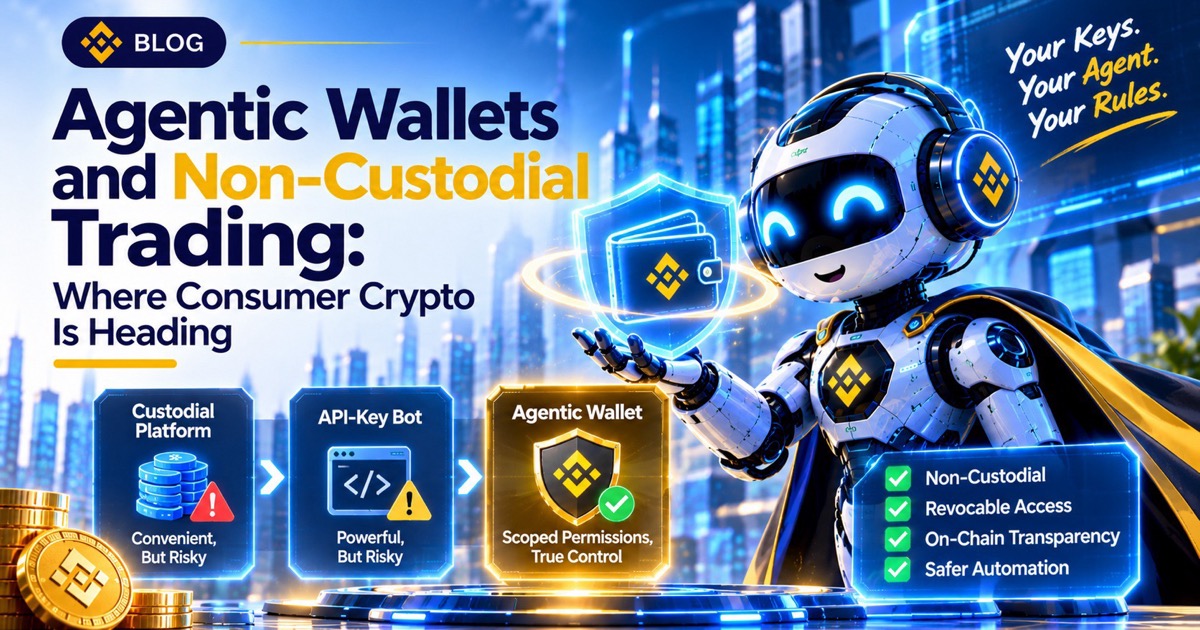
Crypto consumer products have swung between two bad options forever: hand your funds to a platform (custody — convenient, risky) or manage raw keys and API secrets yourself (self-custody — safe-ish, unusable). The Agentic Wallet pattern — a wallet an AI agent can act on with narrow, revocable permissions — is the first design that genuinely beats both. It's also what our trading agent runs on, so we've seen the tradeoffs up close.
The three architectures, honestly compared
- Custodial platform — smooth UX, your funds are their liability, exit is their decision (history's lesson: it eventually matters)
- API-key bot on your exchange account — you keep custody of sorts, but the key is a master secret that must be guarded forever, and permissions are all-or-nothing
- Agentic Wallet — a dedicated wallet the agent can trade inside with scoped permissions; it cannot withdraw, you can revoke in one tap, funds never leave your name
Why scoped permissions change the security math
The old model's flaw is blast radius: one leaked string equals total loss. An agent wallet shrinks the blast radius to the smallest useful set of actions — buy and sell, inside limits, inside one wallet. A compromised agent can, at worst, trade badly within your caps; it cannot drain. Security stops being about protecting a god-key forever and becomes about right-sizing what any single credential can do. That's the same principle behind modern banking limits and production infrastructure access — applied, finally, to consumer crypto.
What it unlocks that custody never could
- Verifiable automation — the agent's every action is on-chain and auditable, not a database entry you must trust
- Trustless pause — disconnect anytime; positions and funds stay exactly where they are
- Composability — the same wallet interacts with DeFi, Alpha tokens and transfers under your name, not an omnibus account
- Self-improving agents with real accountability — every trade our agent makes is attributable, inspectable and reversible only by plan
The friction that remains (honest list)
- Setup still asks more of users than a custodial app — QR pairing and wallet settings are real steps
- Gas and network basics remain user problems — the wallet doesn't abstract chain selection
- Permission design is young — categories like 'trade' are still coarser than they'll eventually be
Where this goes next
The pattern generalizes past trading: agents that pay subscriptions, rebalance portfolios, farm safe yield, manage NFT mints — all inside scoped wallets with spend caps. The wallet becomes the perimeter, the agent becomes a household employee with defined duties, and 'not your keys, not your coins' matures into 'your keys, your agent, your rules.' We build against that future because our users already live in it: our agent has traded from Agentic Wallets since the feature existed, non-custodially, every single day.
Frequently asked questions
- Is an Agentic Wallet the same as giving a bot my keys? — No — you never share keys. The wallet pairs with the agent and grants narrow permissions (buy/sell within limits). Keys and withdrawal capability stay exclusively yours.
- What happens to my positions if I disconnect the agent? — Nothing moves. Open positions stay in your wallet, and with our bot they continue exiting by their pre-set plans; only new entries stop.