AI Trading Agents in 2026: What's Real, What's Marketing, What Actually Works
The phrase 'AI trading agent' went from research paper to product category to marketing sticker in about two years. Half of what wears the badge is a moving-average crossover with a chatbot skin. The other half is a genuine shift in how markets can be traded — and the difference matters when real money is attached.
Here is the honest taxonomy, layer by layer, from someone who builds and runs one of these systems daily against live markets.
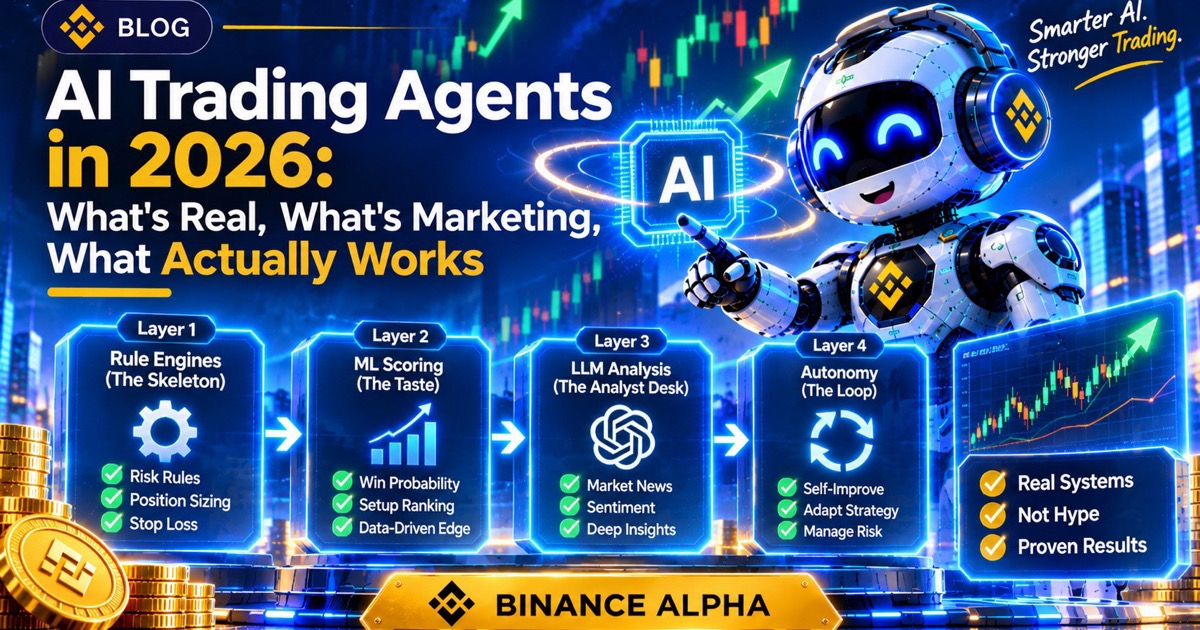
Layer 1 — Rule engines: the skeleton
Every credible system starts as deterministic rules: if the price is above the long trend line, size positions at 2% risk, take profit in stages, stop at a fixed level. No intelligence, all discipline. Boring — and non-negotiable, because it is the layer that bounds every possible outcome of the layers above. An 'AI' without this skeleton is improvisation with extra steps.
Layer 2 — ML scoring: the taste
Machine-learning models trained on historical outcomes add a probability dimension: of these 40 setups that passed the rules, which ones historically paid? Win-probability and ranking models turn a binary 'buy / don't buy' into a ranked list, letting risk concentrate where evidence is strongest. The models our agent uses are retrained on every new batch of closed trades and must pass out-of-sample exams before touching live money — the exam, not the training score, is the credential.
Layer 3 — LLM analysis: the analyst desk
Large language models read what numbers can't: news, narratives, tokenomics documentation, the bull and bear case for a specific setup. Used correctly they are an analyst desk that works for free and never sleeps; used naively they are a confident hallucination machine wired to your order button. The safe architecture — the one we run — keeps the LLM as advisor, never executor: a council of analysts argues, a deterministic risk manager decides, and the code enforces the verdict.
Layer 4 — Autonomy: the loop
The newest layer, and the one that defines 2026's products: the system closes its own feedback loop. It trades, measures its versions, retires what stopped working and promotes what earns the seat — our agent re-scores its strategy versions weekly and rolls back automatically on underperformance. That loop, not any single model, is what makes it an agent rather than a bot: it maintains its own edge the way software maintains itself.
Red flags in the wild
- 'Guaranteed returns' — no serious system says this, ever
- No published methodology — if the mechanism can't be explained, the performance can't be verified
- AI owns the risk parameters — intelligence without boundaries is liability
- Backtest-only evidence with no live track record — especially backtests without fees and slippage
- Screenshots instead of streamed data — curated results are not results
What we'd tell a friend evaluating one
- Ask where the stops and sizing live — in code, or in the model's judgment?
- Ask what happens on a bad week — a real system has a mechanical answer
- Prefer live-streamed performance over any pitch deck — ours shows a real wallet's balance, PnL and positions on the home page, precisely so you don't have to trust us
Frequently asked questions
- Can an LLM trade profitably by itself? — Reading markets, yes — better than most humans at summarizing the state of a token. Owning execution, no: without deterministic risk limits it's fast, confident and unbounded, a bad combination for capital.
- What separates an agent from a bot? — A bot executes fixed rules. An agent executes rules, evaluates how those rules are performing, and improves them on a schedule — the feedback loop is the difference.