Low-Cap Crypto on Binance Alpha: A Field Guide to the Wildest Corner of the Market

Low-cap crypto is where life-changing gains and total losses share a zip code. Binance Alpha packages that world with one-click access and on-chain transparency — but access isn't edge. The edge comes from understanding how this market mechanically behaves, and building a process that survives it.
This guide is what we learned scanning this market every single day — the same observations our trading agent encodes into rules.
What makes a token 'low cap' — and why it behaves differently
Small-cap tokens (think well under a few hundred million dollars) trade in a market with three structural features: thin liquidity, concentrated ownership, and narrative-driven flow. Thin liquidity means a modest buy order moves the price — which cuts both ways. Concentrated ownership means a handful of wallets can decide your chart's direction. Narrative-driven flow means tokens move on stories and rotations, not fundamentals, until suddenly they don't move at all.
The result: low caps trend harder and die faster than large caps. That's not a bug to fix — it's the terrain to trade.
The four ways low caps hurt retail traders
Every one of these is a process failure, not an intelligence failure. Which is exactly why rules beat judgment here more than anywhere else in trading.
- Buying the top of a vertical move — the classic +300% candle bought at the last 10%
- Holding through the -70% unwinding because 'it came back last time'
- Exiting into no liquidity — the sell that moves the price against you by 10% before it fills
- Position sizes that feel small but are still 20% of the account — one bad token, one bad month
The research checklist we run on every token
None of these signals is magic alone. Together they filter a list of hundreds of tokens down to a handful worth risking anything on — that filtering IS the strategy.
- Liquidity first: real depth in the pool, not just a pretty price — can your position size exit within ~2% slippage?
- Holder structure: are the top wallets accumulating quietly, distributing, or dormant? Rising holders on a flat price is the healthiest signal there is
- Trend gate: is price above its long moving average (the ~200-day), i.e., is there an established uptrend to join — or is this a knife to catch?
- Category hygiene: skip memes and RWA pairs where the price is a marketing schedule, not a market
- Funding and open interest (if a perp exists): crowded leveraged longs precede the fastest flushes
- Smart money footprint: are tracked skilled wallets accumulating the same token from multiple addresses?
Market cycles: when low caps breathe
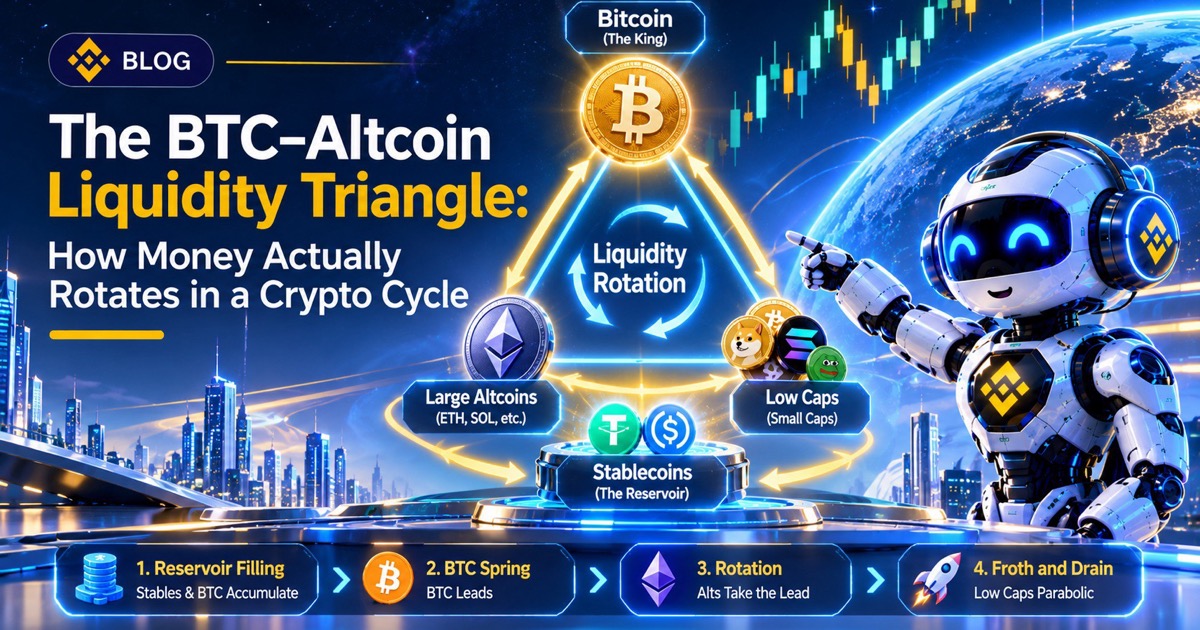
Low caps are a risk-appetite instrument. When Bitcoin trends and the altcoin index rises, capital flows down the risk curve and small caps multiply it. When Bitcoin weakens, that flow reverses first and hardest in exactly the tokens everyone loved last month. A low-cap system without a market-state filter is long volatility with extra steps — which is why our agent measures the broad regime (breadth, funding, sentiment) before sizing anything.
- Strong regime: trend engines get full sizing, breakouts follow through
- Neutral: normal operation, breakouts get checked harder
- Weak regime: fewer, smaller entries — or none; cash is a position
How to actually hold low caps without dying
If you trade them manually, borrow the machine's discipline: size from fixed risk (small % per trade), take profit in stages as the trend extends, stop at a level that invalidates the idea (not a level that feels okay), and cap how many positions you'll juggle at once. Write the plan before the buy, on paper, and let the paper win arguments with your feelings.
Or delegate the discipline: an autonomous agent applies these rules to the whole market daily while you keep custody of funds — which is the entire reason we built one.
The honest summary
Low-cap crypto is a legitimate asset class with illegitimate amounts of noise. The winners we observe over long horizons are not the ones who find more tokens — they're the ones who lose small, repeatedly, mechanically, while letting a few big trends run. Boring process, wild market. That's the whole secret.
Frequently asked questions
- Are Binance Alpha tokens riskier than regular altcoins? — Generally yes — earlier stage, thinner liquidity, more concentrated ownership. Access is one click, but risk per token is higher; position sizing and liquidity checks matter more, not less.
- What's the single best filter for low-cap tokens? — Liquidity relative to your position size. A great thesis you can't exit is just a screenshot. After that: holder behavior and an established trend gate.
- Can a bot trade low caps better than a human? — Not smarter — more consistently. It applies the same filters to every token daily, sizes mechanically, and never holds 'because it'll come back'. In this niche, consistency is the edge.