Swing vs Momentum vs Price Action: Which Trading Strategy Suits a Bot?
Ask ten traders which strategy works and you'll get eleven answers. Ask the data and it says something less exciting and far more useful: different strategies win in different market states — so a serious automated portfolio runs several, weighted by evidence, instead of marrying one.
Here are the three engines our agent runs, what each is actually good at, and what their numbers look like when a bot executes them without emotion.
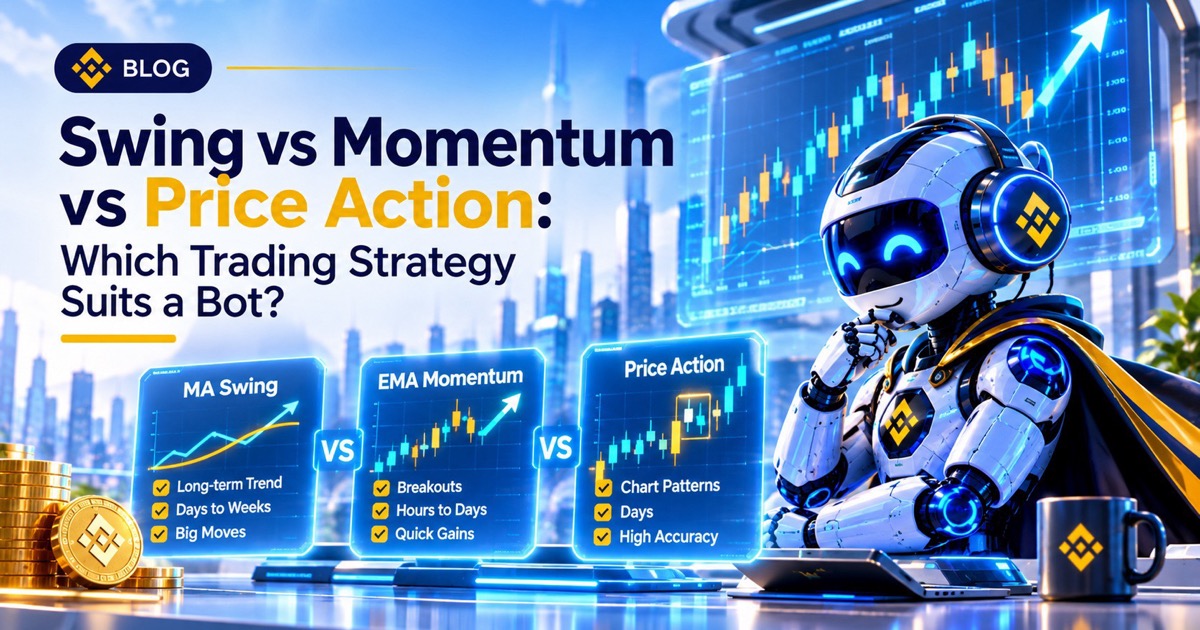
MA Swing — the long-term trend rider
Swing trading rides multi-week trends on strong midcap tokens. The engine's core idea is a trend gate: a token only becomes interesting when its price crosses above its long-term moving average — the moment a new uptrend can be confirmed on daily candles. Entries come early in the trend, exits come in stages as the trend matures.
- Holding period: days to weeks
- Wins by: catching a few large trends per year and riding them in stages
- Weak spot: choppy sideways markets, where trends keep failing at birth
- Character: low trade count, big winners, many small stops — the engine our five-year backtest is built on, the conservative core of the portfolio
EMA Momentum — the short-term wave catcher
Momentum trading hunts fresh breakouts: a token that ignites on volume within hours. The engine tracks short moving-average breakouts, requires confirmation so it doesn't buy fakeouts, and locks gains while the wave runs — fast in, disciplined out, never chasing tops.
- Holding period: hours to days
- Wins by: many quick trades, each banking a piece of a fresh move
- Weak spot: trendless grind where breakouts immediately fail
- Character: high activity, most trades small, occasional huge waves
Price Action — the pattern reader
Price action trading reads the shapes charts make: a bull flag (a strong pole followed by a quiet consolidation, then a breakout), retests of broken levels, compression before expansion. Our newest engine detects these patterns on the top tokens daily and trades the breakout with the same tight risk plan as the others. In backtests over full history it closed 92 trades with a 64.1% win rate and a profit factor of 1.56 — and it runs live only after its validation period completes.
- Holding period: days (average ~9 days per trade in backtest)
- Wins by: stacking decent-probability pattern setups
- Weak spot: patterns need volatility to form — quiet markets starve it
- Character: the diversifier — uncorrelated with the other two engines' signals
Why one strategy is the wrong question
Momentum loves fresh volatility; Swing loves a mature trend; Price Action loves compression breaking out. Those states alternate — no single engine covers them all, and any one engine alone will have flat or drawdown stretches that feel broken. Together, one engine's quiet season is usually another's harvest: the portfolio's equity curve is smoother than any component's.
That's also why 'which is best' backtests mislead: a strategy that dominated the last quarter can be exactly the one that bleeds in the next regime. The defense is diversification across approaches — and an agent that re-scores its versions weekly and rolls back what stops working.
Which one should YOU weight higher?
Our agent runs all three side by side on every plan — you can see each engine's live PnL separately on the strategies page.
- Patient capital, hate checking charts → Swing-dominant behavior suits you
- Want action and can stomach swings → Momentum adds pace and upside bursts
- Believe charts repeat themselves → Price Action is your lens
- Honest answer → run all three equal-weighted and let the market decide
Frequently asked questions
- Which strategy has the highest win rate? — Price Action backtests at 64.1% wins; the trend engines win less often but with bigger average winners. Win rate alone doesn't pay — profit factor and net PnL do.
- Do the three strategies ever fight each other? — Rarely, and it's fine — one may hold a token long-term while another trades a shorter move in it. Position caps and per-trade risk keep the combined exposure bounded.
- Can I turn individual engines off? — Yes — strategy toggles are per wallet in settings, on every plan.