The Life of a Binance Alpha Token: From Listing to Delist, What Actually Happens
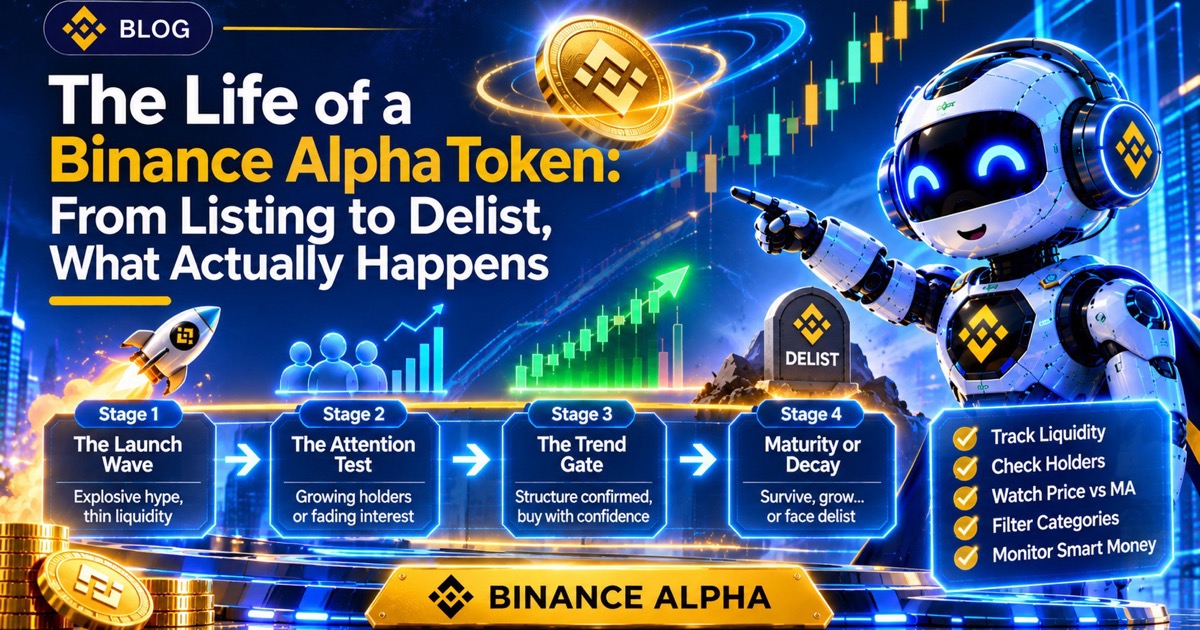
Binance Alpha gives early tokens a stage before the main exchange: one-click access, on-chain transparency, and a brutal audience. Most tokens that appear there follow a recognizable arc — and understanding the arc tells you where the tradable part lives and where the graves are dug.
Stage 1 — The launch wave
New tokens arrive with a burst: thin float, concentrated holders, discovery traffic and a price that moves on five-figure buys. This is the most photogenic and least tradable stage — spreads are wide, slippage is real, and the wallets that 'got in early' often got in before there was a market at all. Serious systems mostly watch this stage rather than trade it: our agent requires tokens to clear liquidity and behavior filters before any engine can touch them.
Stage 2 — The attention test
- Volume either broadens (real interest forming) or decays (launch mercs leaving)
- Holder count quietly grows while price goes flat — the healthiest signal in the entire arc
- Funding and perp markets appear — leverage arriving early usually means volatility is about to be rented, not owned
Stage 3 — The trend gate opens
For trend-followers the game starts here: price crossing above its long moving average with liquidity underneath and breadth confirming. This is where a mechanical system earns its keep — the gate is objective, daily, and applied to every token equally. Entries taken at this stage are backed by structure rather than narrative; the engines our agent runs (swing, momentum, price patterns) all key off this territory.
Stage 4 — Maturity or decay
Some tokens graduate into sustained trends with deepening liquidity — the survivors that eventually target the main exchange. Most don't: attention decays, liquidity thins, and the chart becomes a slow bleed with periodic dead-cat bursts. The delist risk lives here, and it's why maximum hold times matter: a system without a time stop converts 'wait for a comeback' into a portfolio of ghost positions.
How to read any Alpha token in five minutes
- Liquidity vs your position size first — can you exit within ~2% slippage?
- Holder trend on a flat chart — accumulation or distribution?
- Where price sits vs its long average — structure or hope?
- Category check — meme/RWA corners move on schedules, not markets; filter them
- Smart-money footprint — are tracked skilled wallets accumulating or already gone?
Frequently asked questions
- Does a Binance Alpha listing mean Binance endorses the token? — No — Alpha is a discovery venue with listing standards, not a vetting endorsement. Do your own liquidity and holder homework regardless of where a token appears.
- What happens to positions if a token gets delisted? — Trading typically halts and liquidity vanishes fast — another reason the agent enforces max hold times and stops rather than riding tokens into that wall.